Spirits ·
A Reflection on Bourbon, Time, and the American Spirit
A meditation on bourbon — its frontier origins, the alchemy of oak and char, the lost years of Prohibition, and what the slow patience of an aging barrel can teach about the American spirit.
By The Captain
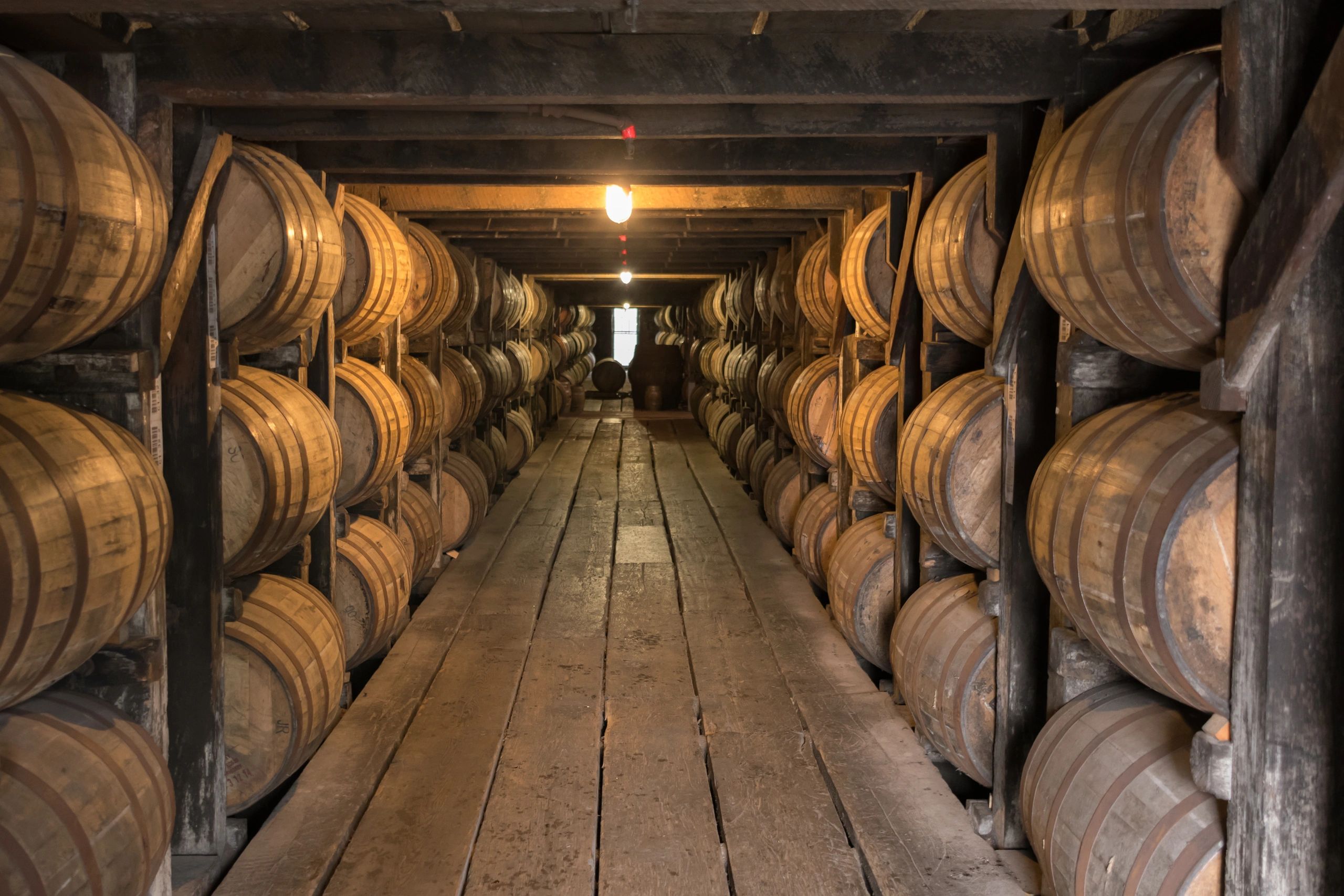
Bourbon Barrels in the Cellar
“The past is never dead. It isn’t even past.”
—William Faulkner
Greetings, fellow travelers.
There’s a quiet moment that comes just before the first sip of bourbon—when the amber catches the light and you remember that this liquid was once corn, fire, and water. You hold it to your lips and realize that you’re not just drinking whiskey; you’re tasting patience. Years of it. Maybe decades. In that warmth lies a story as deep and rough-hewn as the American frontier, and as reflective as an old man watching the last sunlight die in his glass.
I once stood on a Kentucky ridgetop at dusk, overlooking rolling fields that had been cleared by hand two centuries ago. The limestone-filtered creeks below were still cold and pure, feeding the same distilleries that once stood as wooden shacks along the Bourbon Trail. The air smelled faintly of wet earth, oak, and something sweet—fermenting mash, maybe, or memory. It struck me then that bourbon isn’t just a drink. It’s a kind of American scripture, written in oak instead of ink.
I. Corn, Rebellion, and the Birth of a Spirit
The settlers who came to Kentucky in the late eighteenth century didn’t set out to create an icon. They were Scots-Irish farmers, German craftsmen, and restless frontiersmen who carried distilling in their blood. In Virginia and Pennsylvania, they’d made rye whiskey from the grains they knew. But in Kentucky, the land gave them something else: corn. It grew like a promise, tall and stubborn, and it became the heart of a new whiskey unlike any Europe had known.¹
They built small copper stills and began experimenting, blending old-world technique with new-world abundance. The water—rich in limestone—gave purity. The oak—charred to cleanse the barrels—gave color and flavor. Time did the rest.
No one can say exactly when the word “bourbon” appeared, but it likely came from Bourbon County, then part of Virginia, named in honor of the French royal family who had supported the American Revolution.² Early barrels stamped “Bourbon County” floated downriver to New Orleans, where the whiskey inside—aged during the long journey—emerged smoother and darker than the raw white spirits of the frontier. The merchants began asking for more of “that Bourbon whiskey.”
Thus, a name was born not in a marketing meeting, but on the tongues of traders. A drink defined by movement, geography, and chance.
II. The Frontier’s Elixir
The earliest distillers couldn’t have known they were shaping an American archetype. For them, whiskey was sustenance and survival. Grain was hard to transport, but whiskey was compact and durable. A few gallons could buy salt, tools, or a new plow. It became the liquid economy of the frontier.
By the 1790s, when Alexander Hamilton’s excise tax on whiskey ignited rebellion in western Pennsylvania, distillers saw in that tax not fiscal policy but an insult to independence.³ The Whiskey Rebellion of 1794 was quickly crushed by Washington’s militia, but its spirit migrated west with the defeated. Many of those same distillers resettled in Kentucky, Tennessee, and beyond—where they could distill freely. In a sense, bourbon was born from resistance, the taste of liberty rendered liquid.
There’s a reason soldiers, cowboys, and factory workers alike took to bourbon: it spoke their language. It wasn’t aristocratic or foreign. It was democratic, made from the stuff of the land and the sweat of ordinary people. It was the taste of earned rest.
III. The Alchemy of Oak and Fire
To understand bourbon, one must understand the barrel. The law now dictates that all bourbon be aged in new, charred oak barrels, a rule that dates to the nineteenth century.⁴ Charred wood does something miraculous: it creates a natural charcoal filter and caramelizes the sugars within the oak. Over years—sometimes decades—the whiskey seeps in and out of that wood, breathing with the seasons. Summers expand the liquid deep into the char; winters pull it back out. Every cycle brings more complexity—vanilla, caramel, smoke, spice.
Standing inside a rickhouse (a bourbon aging warehouse), you can hear time working. The air hums faintly with the sound of wood expanding and contracting, the scent of angels’ share rising where evaporation steals away a portion of the spirit. It’s strangely reverent. You feel you’re in the company of time itself.
In an age obsessed with speed, bourbon insists on slowness. You can’t rush an honest spirit. Like wisdom, it requires waiting.
IV. Prohibition and the Lost Years
Then came 1920—the great drought. When the Eighteenth Amendment took effect, bourbon went underground.⁵ Barrels were smashed, stills dismantled, and entire families’ livelihoods erased overnight. Yet the spirit survived, as all stubborn traditions do. A few distilleries were granted medicinal licenses, their bottles labeled as “for temperance or therapeutic use.” It’s hard not to smile at the irony—our grandfathers were cured, it seems, by a bit of bourbon every evening.
When Prohibition ended in 1933, the industry was a shadow of its former self. World wars, economic hardship, and industrial consolidation followed. Bourbon survived, but just barely, its rough edges sanded to suit the lighter tastes of postwar America. By the 1970s, it was nearly forgotten—eclipsed by Scotch and vodka.⁶
And yet, bourbon is nothing if not resilient. As the late distiller Booker Noe once said, “You can’t keep a good spirit down.”⁷
V. The Renaissance of the Barrel
By the late twentieth century, a quiet revolution began in the hollers of Kentucky. Small-batch distillers—families like the Beams, Samuels, and Van Winkles—started reviving old recipes, aging methods, and even forgotten yeast strains. They didn’t chase mass production; they chased quality. The results were revelatory.
Single-barrel expressions like Blanton’s and small-batch bourbons like Booker’s changed everything.⁸ They proved that bourbon could be nuanced, even elegant, without losing its backbone. Whiskey tasting evolved from backroom habit to cultural ritual. Connoisseurs debated mash bills and barrel proofs with the fervor of theologians.
It wasn’t nostalgia—it was a renaissance. Bourbon reclaimed its place not just as a drink, but as an art form.
VI. The Philosophy of the Pour
Bourbon teaches patience, but also humility. Every bottle is the product of variables beyond control—heat, humidity, wood grain, even the microflora of the warehouse. A distiller can guide the process but never command it. There’s a lesson there: mastery doesn’t mean domination, but collaboration with nature and time.
And there’s poetry, too. Each sip carries the ghosts of centuries—the settlers who first mashed their corn, the bootleggers who hid barrels in caves, the distillers who kept the flame alive through lean years. Bourbon is history you can taste, if you know how to listen.
Whenever I drink it, I’m reminded that good things—true things—take time. You can’t fake aging. You can’t simulate integrity. The barrel either imparts it, or it doesn’t.
VII. The Modern Mythos
Today, bourbon is both high art and populist anthem. It’s served in crystal tumblers and enamel mugs alike. The irony, of course, is that its luxury status belies its egalitarian origins. Pappy Van Winkle now sells for thousands, while the distillers’ great-grandfathers would have sold it by the jug.
But that duality is what makes bourbon distinctly American. It’s both humble and aspirational, grounded and ambitious. It reflects the contradictions of a nation that reveres tradition even as it reinvents itself endlessly.
There’s a certain nobility in that. Bourbon doesn’t apologize for what it is—it stands as proof that craftsmanship and authenticity can outlast trends.
VIII. Fire, Oak, and Memory
Once, in a quiet rickhouse outside Bardstown, I stood beside a master distiller who had spent more years among barrels than I had on this earth. The air was thick with the scent of angel’s share—the part of the bourbon the heavens claim for themselves. We drew whiskey from a twelve-year-old cask, its color deep as honey in the dying light. The man didn’t speak as I raised the glass. He only watched, as if waiting to see whether I’d hear what the silence was saying.
I did. The stillness carried the creak of old timber, the soft sigh of whiskey breathing through oak, and something older still—time itself, whispering patience. What I tasted wasn’t just bourbon. It was lineage: the farmers who planted corn with blistered hands, the soldiers who shared flasks in the mud, the distillers who guarded their craft through lean years and blind laws. Every drop carried the weight of those who believed that care, time, and work could make something worth passing on.
So I pour another glass now and raise it to the quiet—to the night that listens, to the comrades still walking their own long roads, and to those who’ve gone ahead where the light burns steady. The bourbon catches the firelight and glows like old amber, sweet with memory and smoke. For a moment, the years draw close, and the air feels full of ghosts who are not mourned but honored.
I drink to them all—the living and the gone—and to the fire that keeps us bound. The bourbon burns soft and steady, like friendship that endures, like the kind of courage that needs no audience.
I set the glass down, watch the last drop catch the light, and think how even the roughest spirit can be made gentle by time and care.
The night exhales, and so do I.
Endnotes
- Michael Veach, Kentucky Bourbon Whiskey: An American Heritage (Lexington: University Press of Kentucky, 2013), 15–22.
- Henry Crowgey, Kentucky Bourbon: The Early Years of Whiskeymaking (Lexington: University Press of Kentucky, 1971), 41–44.
- Thomas Slaughter, The Whiskey Rebellion: Frontier Epilogue to the American Revolution (New York: Oxford University Press, 1986), 212–218.
- Regan, Gary and Mardee Haidin Regan, The Book of Bourbon and Other Fine American Whiskeys (New York: Houghton Mifflin, 1998), 53.
- Daniel Okrent, Last Call: The Rise and Fall of Prohibition (New York: Scribner, 2010), 162–166.
- Chuck Cowdery, Bourbon, Straight: The Uncut and Unfiltered Story of American Whiskey (Chicago: Made and Bottled in Kentucky, 2004), 183–189.
- Fred Minnick, Bourbon: The Rise, Fall, and Rebirth of an American Whiskey (Minneapolis: Voyageur Press, 2016), 117.
- Clay Risen, American Whiskey, Bourbon & Rye: A Guide to the Nation’s Favorite Spirit (New York: Sterling Epicure, 2013), 44–48.
Bibliography
Crowgey, Henry G. Kentucky Bourbon: The Early Years of Whiskey making. Lexington: University Press of Kentucky, 1971.
Cowdery, Chuck. Bourbon, Straight: The Uncut and Unfiltered Story of American Whiskey. Chicago: Made and Bottled in Kentucky, 2004.
Minnick, Fred. Bourbon: The Rise, Fall, and Rebirth of an American Whiskey. Minneapolis: Voyageur Press, 2016.
Okrent, Daniel. Last Call: The Rise and Fall of Prohibition. New York: Scribner, 2010.
Regan, Gary, and Mardee Haidin Regan. The Book of Bourbon and Other Fine American Whiskeys. New York: Houghton Mifflin, 1998.
Risen, Clay. American Whiskey, Bourbon & Rye: A Guide to the Nation’s Favorite Spirit. New York: Sterling Epicure, 2013.
Slaughter, Thomas. The Whiskey Rebellion: Frontier Epilogue to the American Revolution. New York: Oxford University Press, 1986.
Veach, Michael R. Kentucky Bourbon Whiskey: An American Heritage. Lexington: University Press of Kentucky, 2013.
About the Author
Cliff “The Captain” Ryan is a military historian and storyteller. He reads primary sources when he can, footnotes when the piece earns it, and writes about battles, campaigns, and the men who led them — what they got right, what they got wrong, and what still applies to anyone trying to do hard work well.
He is the creator of Captain’s War Chronicles, where the echoes of battle meet the lessons of history, and the host of The Captain’s Cellar, a reflective space for the long view — history, leadership, and the rituals that reward patience.
Both sites are part of The Chronicler Library, a family of slow, sourced, built-to-last writing.
Originally published at the live site .